9 Oct 2026
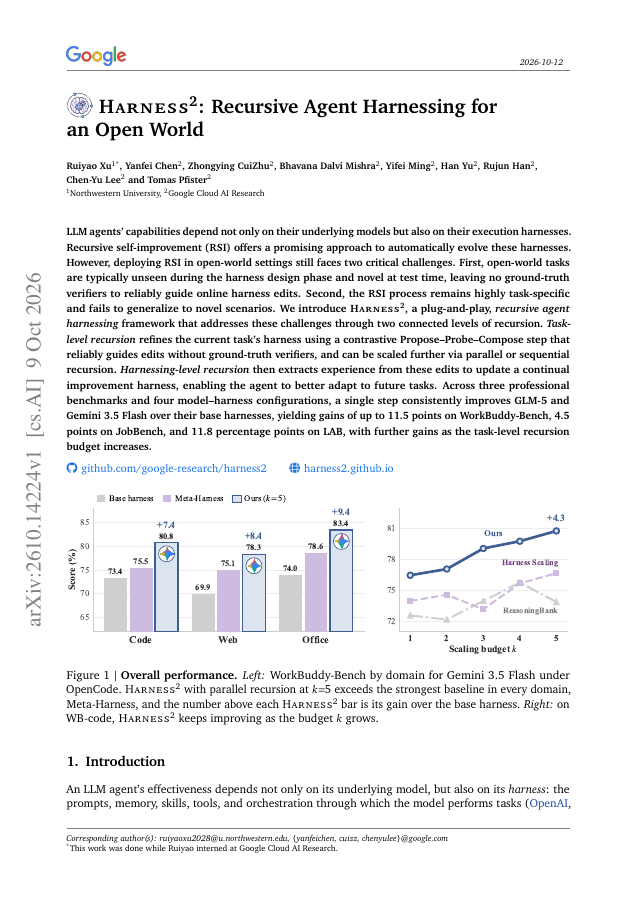
LLM agents' capabilities depend not only on their underlying models but also on their execution harnesses. Recursive self-improvement (RSI) offers a promising approach to automatically evolve these harnesses.
Trending research and the full catalog - each paper linked to the benchmarks, methods, and models it introduces.
Filtering here covers the 2,000 most recent papers, as much as one page can hold in memory. See the full index of 22,712 papers.
9 Oct 2026
LLM agents' capabilities depend not only on their underlying models but also on their execution harnesses. Recursive self-improvement (RSI) offers a promising approach to automatically evolve these harnesses.
20 Oct 2026
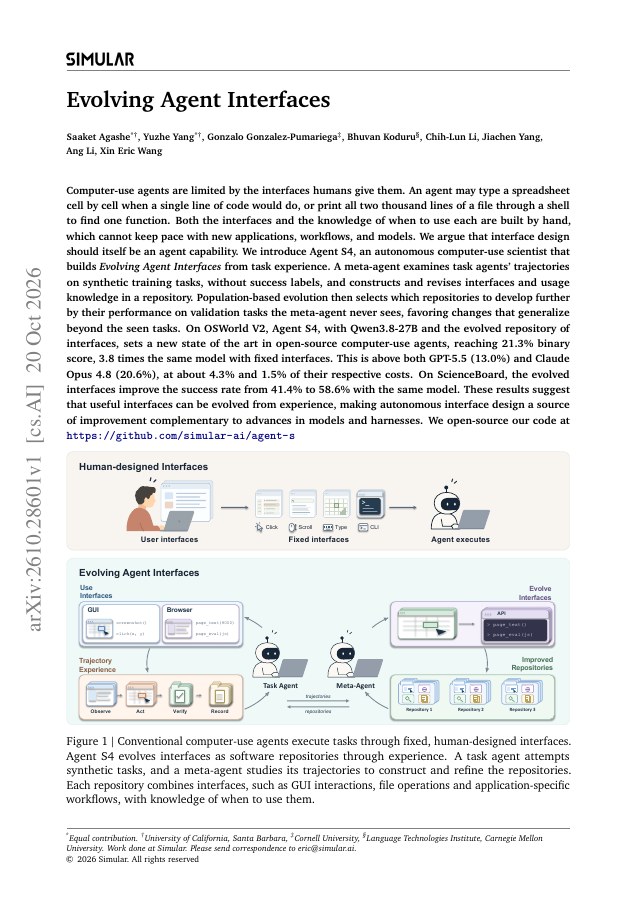
Computer-use agents are limited by the interfaces humans give them. An agent may type a spreadsheet cell by cell when a single line of code would do, or print all two thousand lines of a file through a shell to find one function.
15 Oct 2026
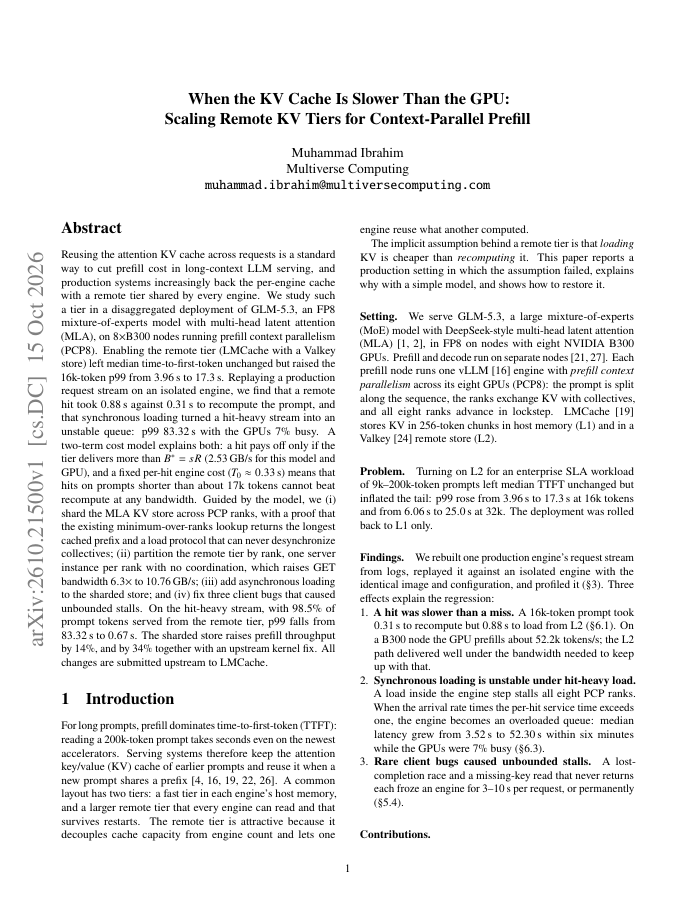
Reusing the attention KV cache across requests is a standard way to cut prefill cost in long-context LLM serving, and production systems increasingly back the per-engine cache with a remote tier shared by every engine.
8 Oct 2026
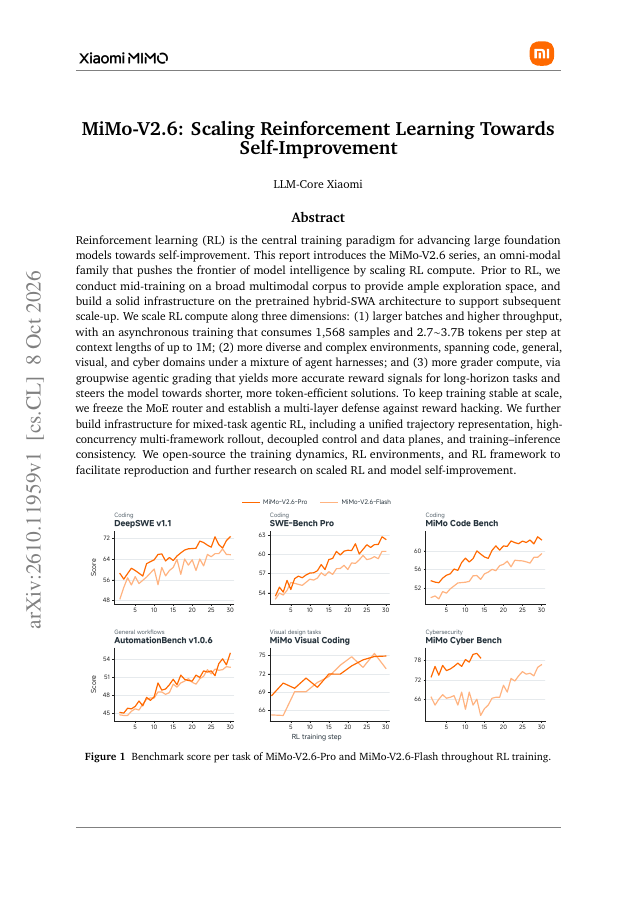
Reinforcement learning (RL) is the central training paradigm for advancing large foundation models towards self-improvement. This report introduces the MiMo-V2.6 series, an omni-modal family that pushes the frontier of model intelligence by scaling RL compute.
6 Oct 2026
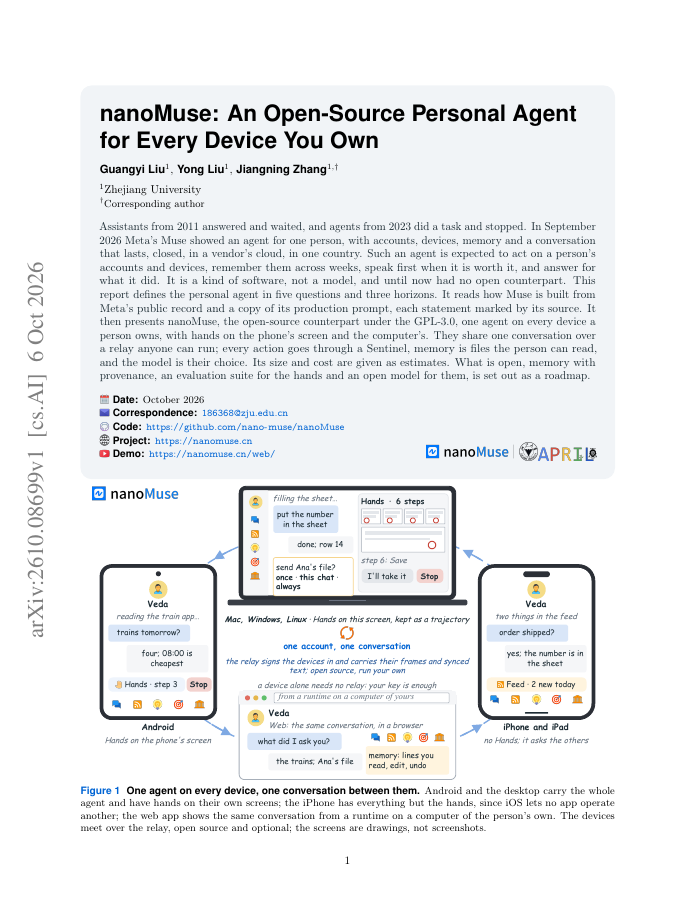
Assistants from 2011 answered and waited, and agents from 2023 did a task and stopped. In September 2026 Meta's Muse showed an agent for one person, with accounts, devices, memory and a conversation that lasts, closed, in a vendor's cloud, in one country.
13 Oct 2026
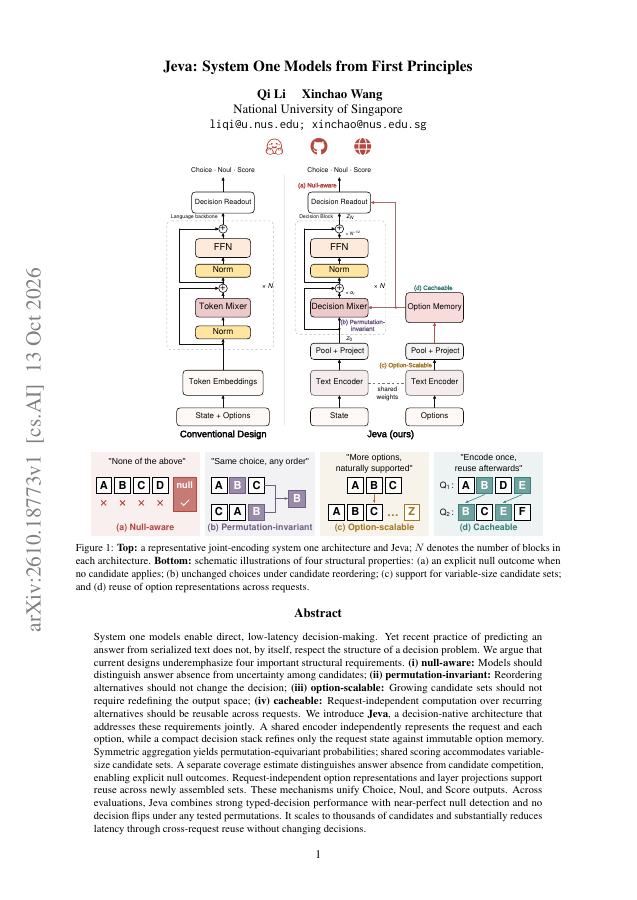
System one models like Jev enable direct, low-latency decision-making. Yet recent open-source practice of predicting an answer from serialized text does not, by itself, respect the structure of a decision problem.
19 Oct 2026
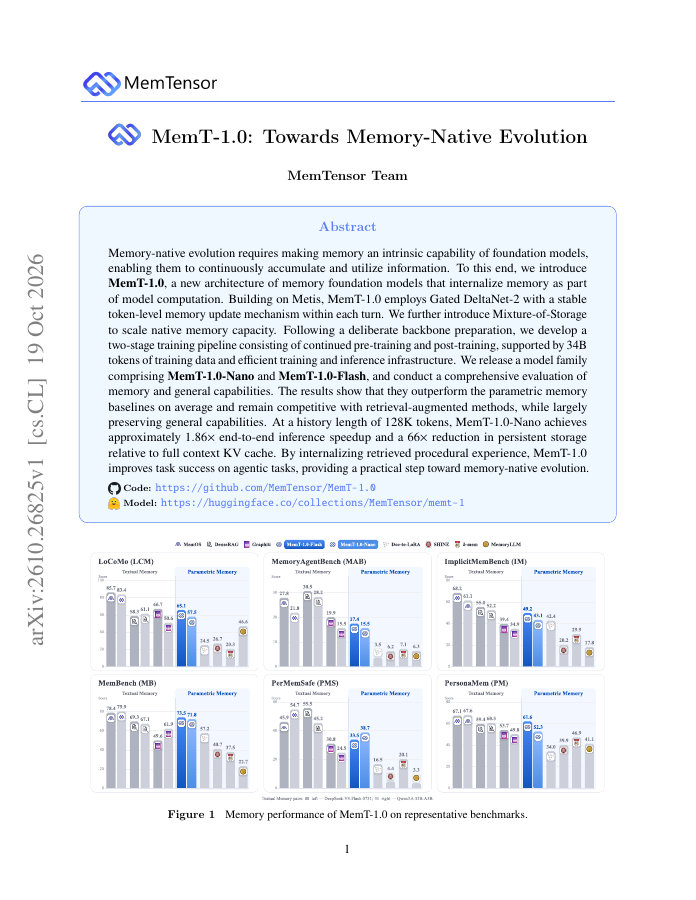
Memory-native evolution requires making memory an intrinsic capability of foundation models, enabling them to continuously accumulate and utilize information. To this end, we introduce MemT-1.0, a new architecture of memory foundation models that internalize memory as part of…
9 Oct 2026
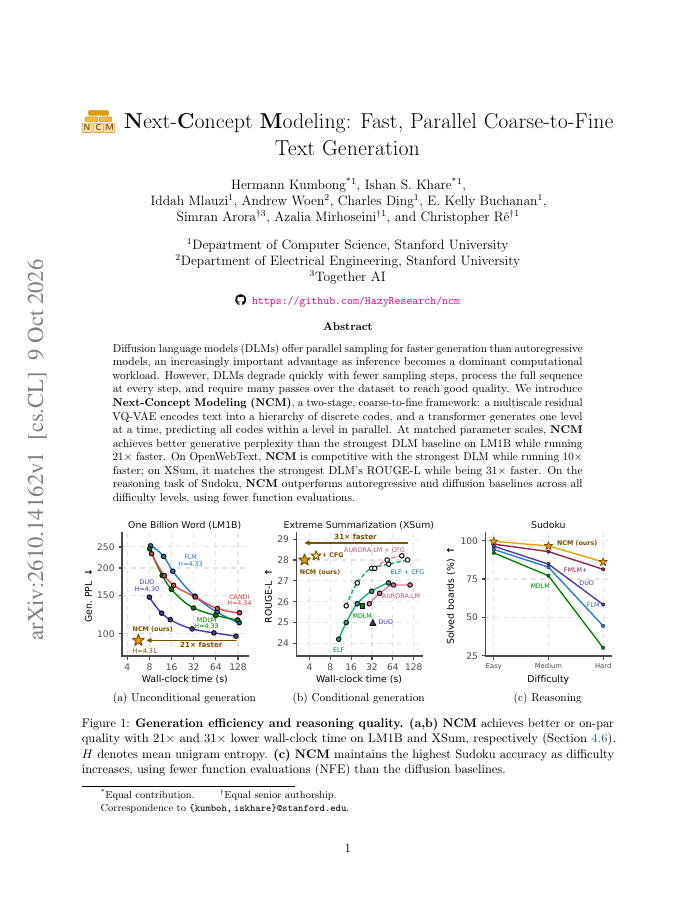
Diffusion language models (DLMs) offer parallel sampling for faster generation than autoregressive models, an increasingly important advantage as inference becomes a dominant computational workload.
13 Oct 2026
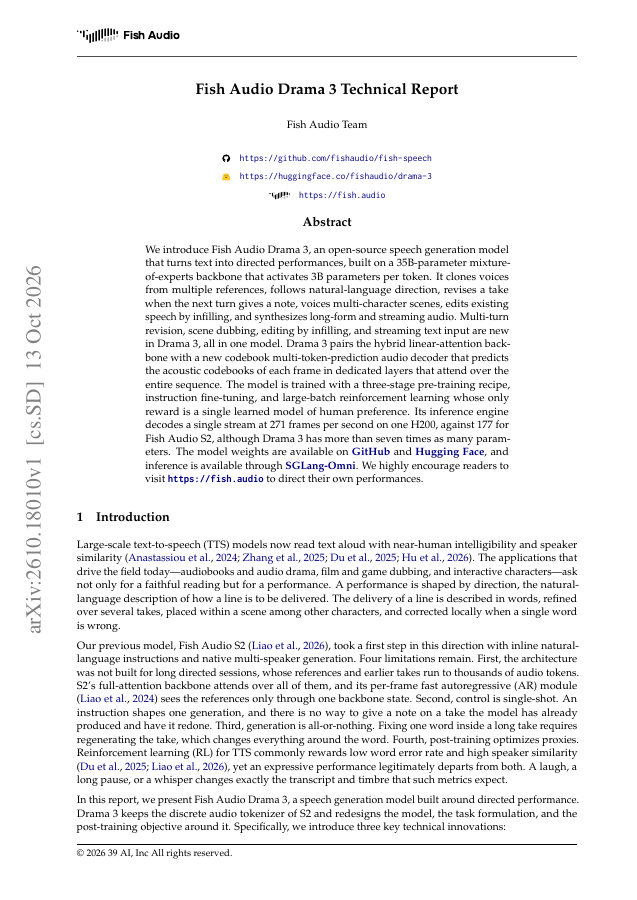
We introduce Fish Audio Drama 3, an open-source speech generation model that turns text into directed performances, built on a 35B-parameter mixture-of-experts backbone that activates 3B parameters per token.
15 Oct 2026
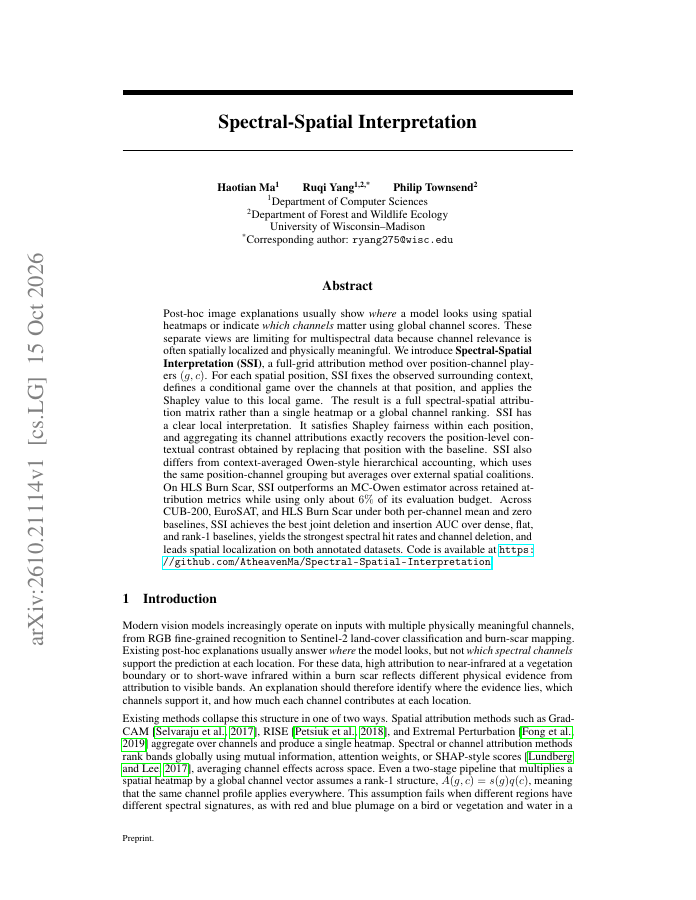
Post-hoc image explanations usually show where a model looks using spatial heatmaps or indicate which channels matter using global channel scores. These separate views are limiting for multispectral data because channel relevance is often spatially localized and physically…
13 Oct 2026
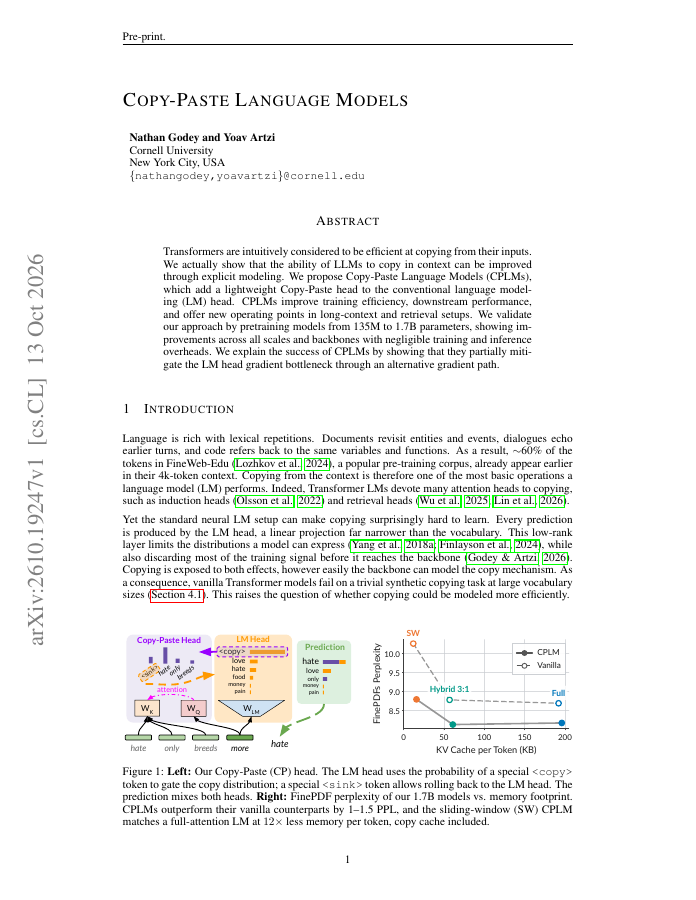
Transformers are intuitively considered to be efficient at copying from their inputs. We actually show that the ability of LLMs to copy in context can be improved through explicit modeling.
4 Oct 2026
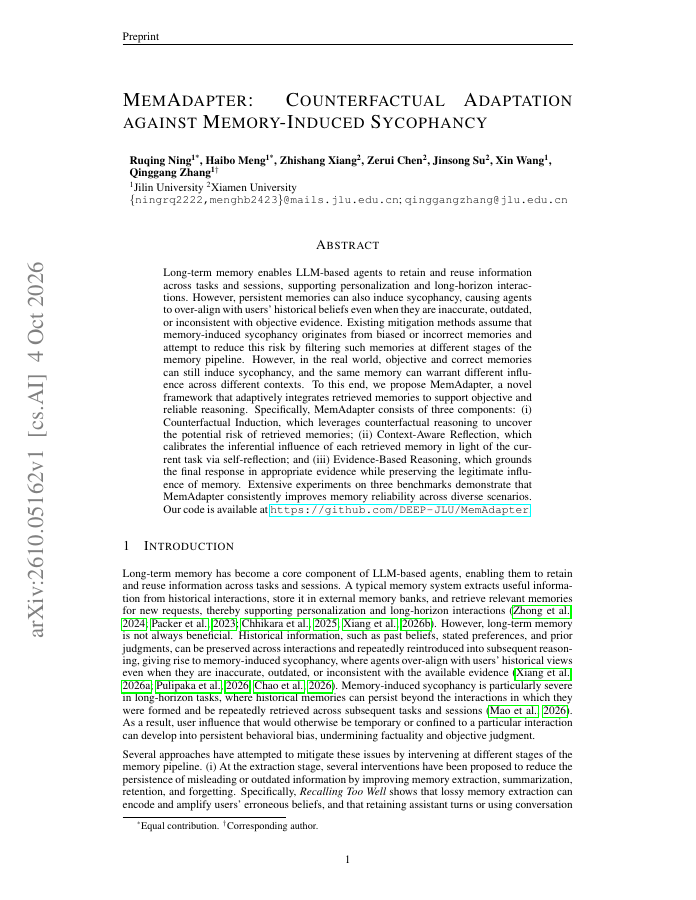
Long-term memory enables LLM-based agents to retain and reuse information across tasks and sessions, supporting personalization and long-horizon interactions. However, persistent memories can also induce sycophancy, causing agents to over-align with users' historical beliefs…
22 Oct 2026
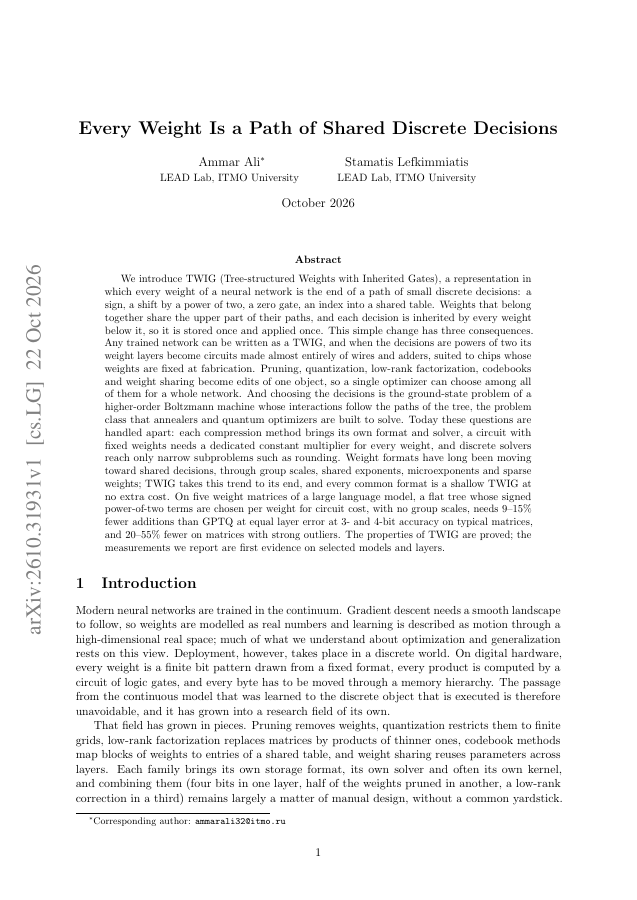
We introduce TWIG (Tree-structured Weights with Inherited Gates), a representation in which every weight of a neural network is the end of a path of small discrete decisions: a sign, a shift by a power of two, a zero gate, an index into a shared table.
1 Oct 2026
Scientific progress emerges from a longitudinal ecosystem in which researchers, institutions, funding agencies, collaboration networks, and the scientific literature co-evolve.
13 Oct 2026
Generating information-rich visual artifacts such as slides, posters, and dashboards as code is appealing because the outputs are structured, editable, and verifiable. Yet code models cannot see how their choices of layout and color come together on the canvas, often limiting…
21 Oct 2026
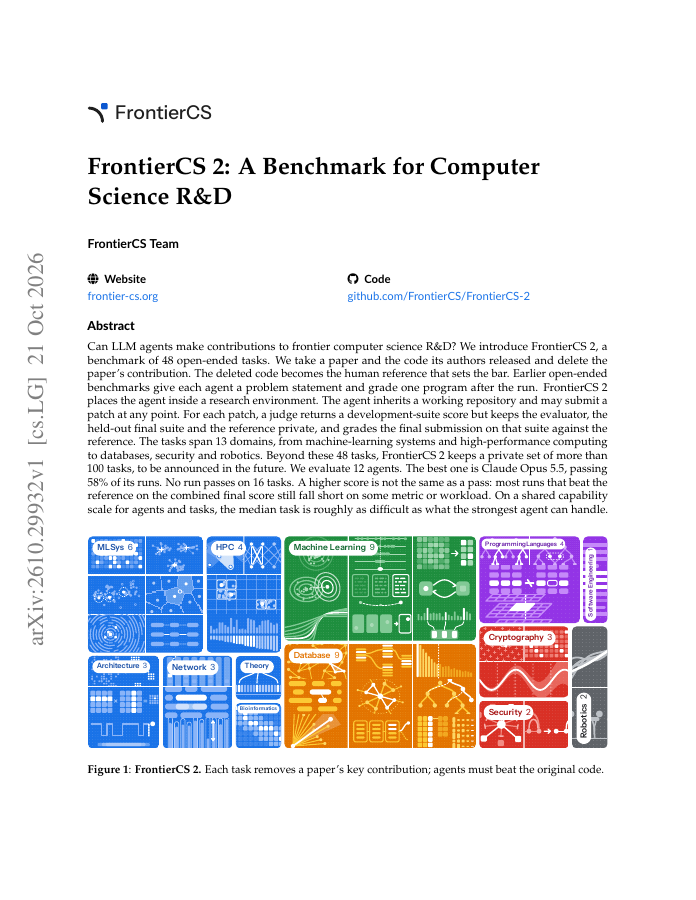
Can LLM agents make contributions to frontier computer science R&D? We introduce FrontierCS 2, a benchmark of 48 open-ended tasks. We take a paper and the code its authors released and delete the paper's contribution.
21 Oct 2026
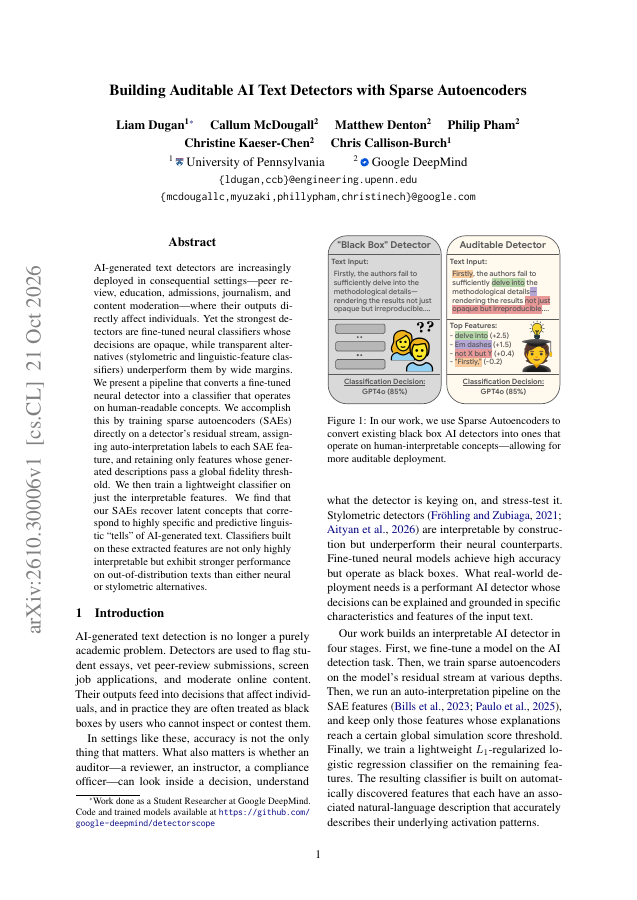
AI-generated text detectors are increasingly deployed in consequential settings---peer review, education, admissions, journalism, and content moderation---where their outputs directly affect individuals.
8 Oct 2026
Long-horizon agents compact their history to continue within a finite context window, but a textual summary alone may not support every subsequent decision. We introduce REMORY, a neural memory network that supplements the summary with a bounded sequence of soft memory tokens.
13 Oct 2026
Reinforcement learning (RL) has emerged as the primary paradigm for optimizing Large Language Model (LLM) agents, yet efficient critic-free algorithms (e.g., GRPO) suffer from a fundamental uniform credit assignment dilemma that broadcasts trajectory-level advantages equally to…
2 Oct 2026
Full-duplex voice agents make many small, closed decisions, which current systems answer by slow autoregressive decoding. We propose DuplexJev, which feeds ASR-encoder hidden states through a small connector into a frozen LLM and reads each question as a single-token…
15 Oct 2026
Large language model agents solve tasks through long sequences of tool calls, and the prevailing design has a single strong model generate every step, although many steps are routine enough for a much smaller model.
7 Oct 2026
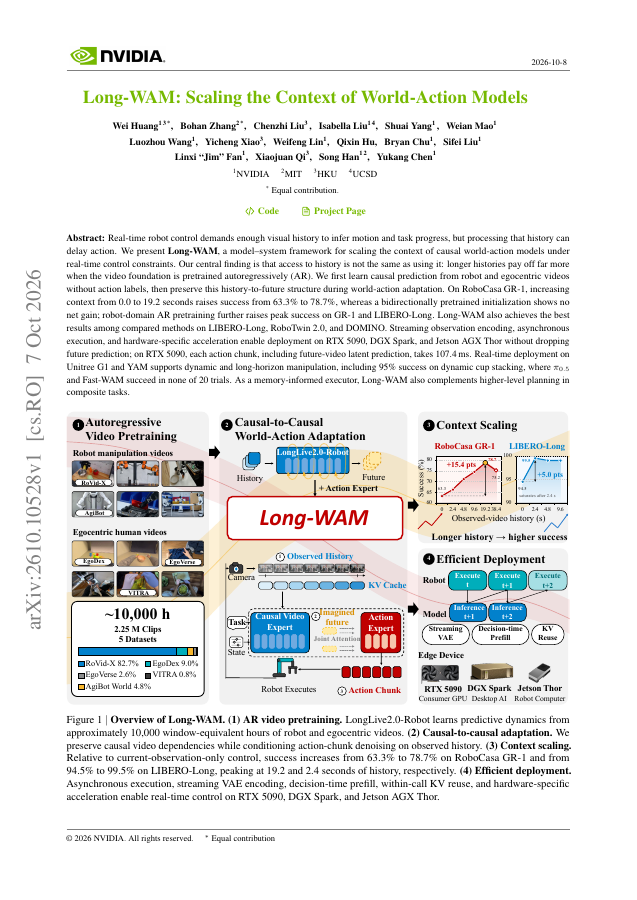
Real-time robot control demands enough visual history to infer motion and task progress, but processing that history can delay action. We present Long-WAM, a model-system framework for scaling the context of causal world-action models under real-time control constraints.
21 Oct 2026
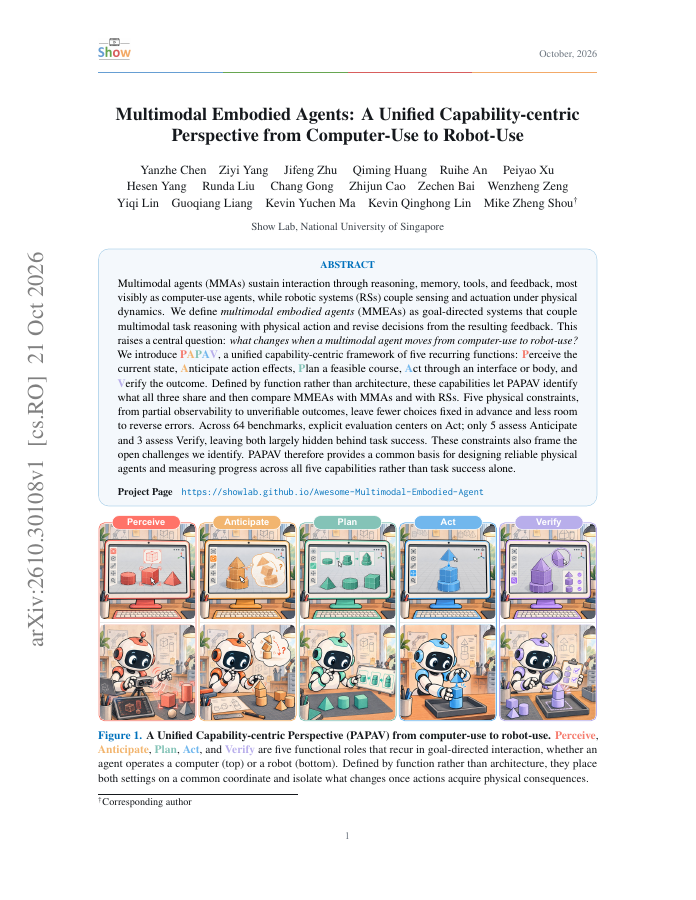
Multimodal agents (MMAs) sustain interaction through reasoning, memory, tools, and feedback, most visibly as computer-use agents, while robotic systems (RSs) couple sensing and actuation under physical dynamics.
16 Oct 2026
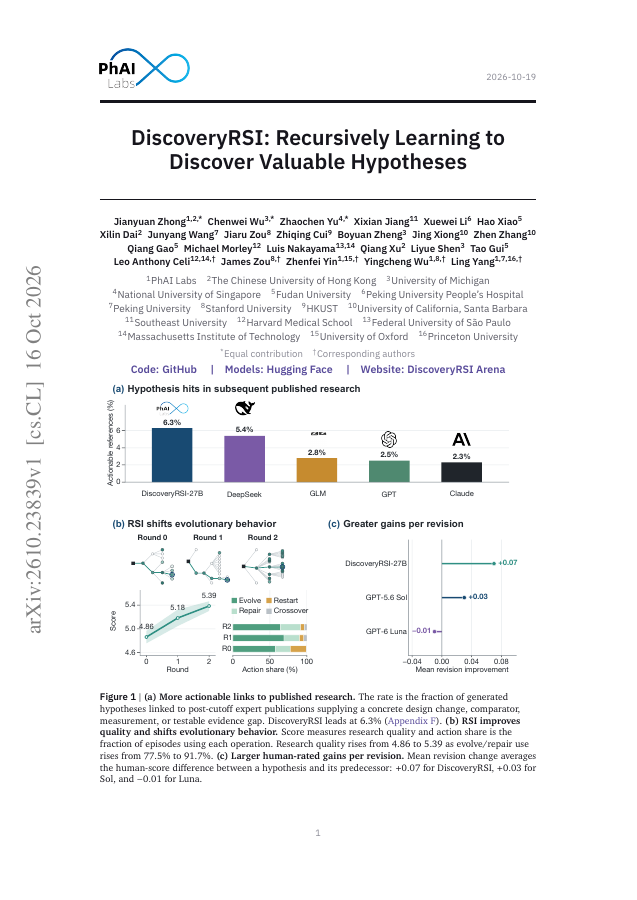
Scientific discovery requires developing worthwhile hypotheses into practical investigations, yet learning from this evolving research process remains challenging. We introduce an operational definition of valuable and testable research hypotheses: evidence-grounded claims about…