20 Aug 2026
LLM agents learn by interacting with environments, yet these environments are hand-built and static: blind to an agent's weaknesses, and quickly left behind as it improves.
Trending research and the full catalog - each paper linked to the benchmarks, methods, and models it introduces.
20 Aug 2026
LLM agents learn by interacting with environments, yet these environments are hand-built and static: blind to an agent's weaknesses, and quickly left behind as it improves.
19 Aug 2026
Continuous self-improvement requires an ever-expanding pool of self-generated, diverse, adaptive goals. For language agents, existing training environment pools (hand-curated, statically synthesized, or frozen-verifier) keep the goal distribution fixed as the learner scales.
19 Aug 2026
Training terminal agents requires scalable executable supervision, yet synthesizing high-quality terminal tasks remains challenging. Each task couples an instruction, an initialized environment, a reference solution, and an executable verifier; if these artifacts are generated…
18 Aug 2026
Modern agents operate inside agent harnesses that manage tools, context, and control flow, making the harness a critical part of the agent system. Our original Agent Lightning introduced a disaggregated architecture that connects arbitrary agents to RL training through an LLM…
18 Aug 2026
Artificial superintelligence (ASI) requires AI to move beyond mastering existing knowledge toward exploring the unknown, creating new knowledge, and turning new ideas into verifiable results.
20 Aug 2026
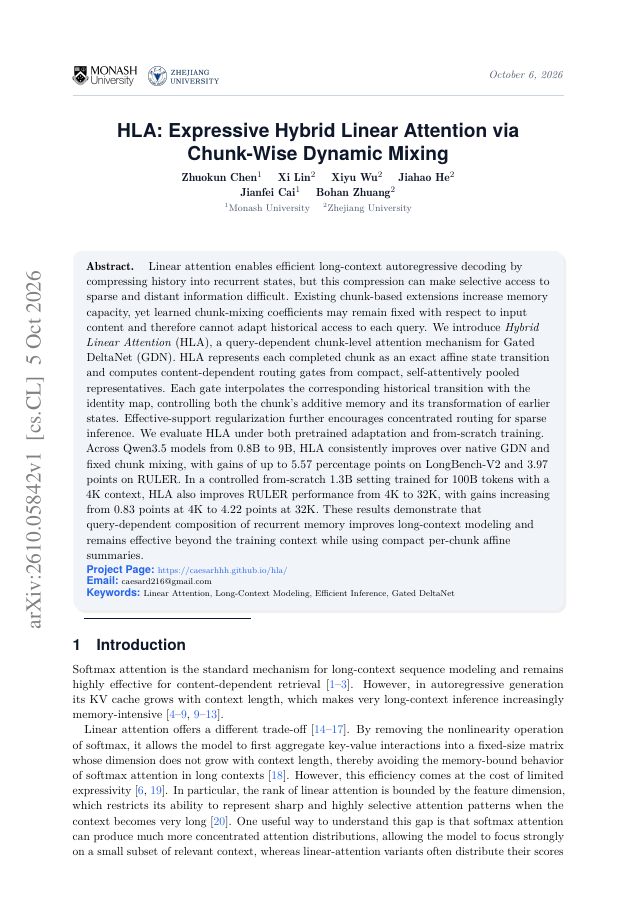
Long-context modeling is a pivotal capability for Large Language Models, yet the quadratic complexity of attention remains a critical bottleneck, particularly during the compute-intensive prefilling phase.
18 Aug 2026
Reinforcement learning for coding agents increasingly relies on long-running agent harnesses to manage tool integration, repository contexts, and execution feedback. However, the native execution environments of these harnesses are inherently misaligned with policy-gradient…
18 Aug 2026
Reinforcement Learning (RL) has been promising in single-turn LLM fine-tuning. However, long-horizon agentic reasoning introduces increasingly branching interactions and sparse rewards, exposing several limitations of RL: its heavyweight backpropagation-based training stack…
20 Aug 2026
Software increasingly functions as part of the scientific instrument itself, making failures in scientific code capable of compromising not only program behavior but also the evidence underlying scientific conclusions.
18 Aug 2026
Reinforcement learning (RL) has emerged as a powerful approach for improving reasoning in language and vision-language models, yet its strongest successes still depend heavily on ground-truth supervision (e.g., verifiable reward).
19 Aug 2026
Language model agents now execute bounded tasks reliably. Whether they can sustain effective decision-making over long horizons, where actions have cumulative consequences and the environment responds to their choices, remains largely unmeasured.
18 Aug 2026
We introduce Semantic Task Completion Video Generation, an outcome-oriented video generation task. Under this formulation, success requires both achievement of the intended outcome and semantic grounding.
18 Aug 2026
Large language models are increasingly deployed through agent harnesses that manage tools, extensions, persistent state, permissions, and external actions. Existing safety benchmarks mainly target individual attack mechanisms or a limited subset of operational settings, making…
19 Aug 2026
Large language model (LLM) based agents have demonstrated remarkable proficiency in automated software issue resolution, yet they often struggle to resolve issues in a specific repository because they lack project-specific knowledge.
19 Aug 2026
Agent frameworks increasingly package procedural knowledge as skills: instruction files an agent reads on demand, while public libraries now hold thousands of them. Which skill to read has thus become a decision the policy itself makes in the middle of an episode, yet no…
19 Aug 2026
Mechanistic interpretability seeks quantities that models do not expose directly: represented states, component effects, interactions, and responses to interventions. Patching, gradients, Hessian-vector products, and subset interventions provide different measurements under…
20 Aug 2026
Memory has become a key component of large language models, enabling them to retain information and learn from long-term interactions. However, existing memory benchmarks mainly evaluate whether information is correctly extracted, stored, and retrieved, while largely overlooking…
20 Aug 2026
Customer-service LLM agents must follow organizational policy when acting on a user's behalf. Compliance failures arise from either forbidden actions, such as granting an ineligible change, or omitted procedural requirements, such as identification or confirmation.
18 Aug 2026
We introduce PTXBench, a benchmark for evaluating and adapting large language models (LLMs) to use architecture-specific PTX for GPU kernel optimization. PTXBench measures functional correctness, whether selected target instructions execute at runtime, and speedup over frontier…