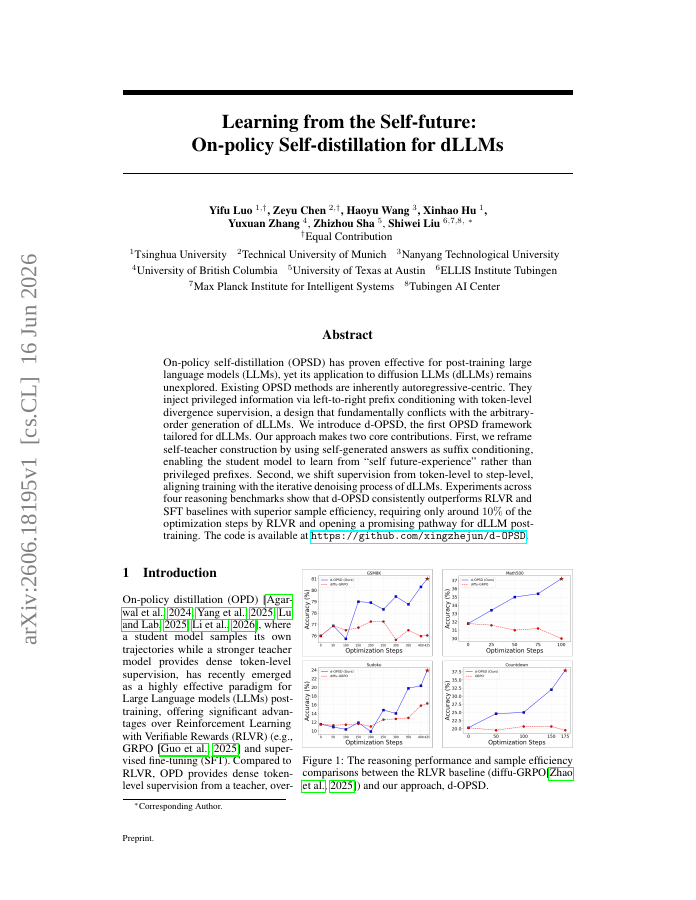
On-policy self-distillation (OPSD) has proven effective for post-training large language models (LLMs), yet its application to diffusion LLMs (dLLMs) remains unexplored. Existing OPSD methods are inherently autoregressive-centric. They inject privileged information via left-to-right prefix conditioning with token-level divergence supervision, a design that fundamentally conflicts with the arbitraryorder generation of dLLMs. We introduce d-OPSD, the first OPSD framework tailored for dLLMs. Our approach makes two core contributions. First, we reframe self-teacher construction by using self-generated answers as suffix conditioning, enabling the student model to learn from "self future-experience" rather than privileged prefixes. Second, we shift supervision from token-level to step-level, aligning training with the iterative denoising process of dLLMs. Experiments across four reasoning benchmarks show that d-OPSD consistently outperforms RLVR and SFT baselines with superior sample efficiency, requiring only around 10% of the optimization steps by RLVR and opening a promising pathway for dLLM posttraining. The code is available at https://github.com/xingzhejun/d-OPSD.
Learning from the Self-future: On-policy Self-distillation for dLLMs
On-policy self-distillation (OPSD) has proven effective for post-training large language models (LLMs), yet its application to diffusion LLMs (dLLMs) remains unexplored. Existing OPSD methods are inherently autoregressive-centric.
- Preview
- Year
- 2026
- Stars
- 4
- Hosting
- Full text hostedCC-BY-4.0
Cite
Notes
Only stored in your browser.
Attribution
- Abstract & full text
- arxiv.org/abs/2606.18195CC-BY-4.0
- TL;DR
- Semantic Scholar